Is Lycra Polyester? No—and It's Not the Only Textile Question I Was Wrong About
Opening Scene
It was a Tuesday in February 2024 when our senior designer asked me a question that should have been simple: 'Is Lycra polyester?'
I've been the office administrator at a 120-person activewear company since 2020. I manage roughly $180,000 a year in purchasing—office supplies, sample packaging, and the occasional guest suite refresh. I report to both operations and finance, which means I care about two things: invoices that don't bounce and colleagues who don't find excuses to avoid the break room.
Textile chemistry was not on my resume.
Background: The Admin Buyer Who Didn't Know Fibers
In my first few years, I didn't need to know the difference between a polyamide and a polyester. We had an approved vendor list and a habit of buying the same things we'd always bought. Then in 2023, our product team decided to expand into a plus-size activewear line. That decision landed on my desk in the form of a spec sheet with the note: 'Need Lycra fabric for plus size lycra pants womens — also, explain why it's different from polyester.'
I remember thinking, 'This is why I order paper towels.'
But it was a real question, and a fair one. Lycra is a name that gets thrown around like it's a fabric, or a synonym for spandex, or sometimes even polyester. It's none of those things, exactly.
The Fiber Lesson That Changed Everything
I called our most patient fabric supplier, a mill rep who had been explaining these details to buyers for twenty years. His response was slower and more careful than I expected:
'Lycra is a brand of elastane. Spandex is the generic name in the U.S. Elastane is the generic name in Europe. Polyester is a completely different synthetic fiber. When you say Lycra fabric, you usually mean a fabric that contains a small percentage of Lycra fiber blended with nylon, cotton, or polyester.'
The 'or polyester' part surprised me. After all, the question 'is Lycra polyester' had an obvious no—but you can blend Lycra with polyester. That's where the confusion gets sticky.
I asked for a simple breakdown, and he gave me one that I still use:
- Lycra = a branded elastane/spandex fiber, used in small amounts (usually 2–20%) to add stretch and recovery.
- Polyester = a synthetic fiber that does not stretch much on its own. It's valued for strength, drying, and hold.
- Nylon = another synthetic fiber, often used with Lycra in performance fabrics because it's smooth and resilient.
That's the short version. The full version involves polymers and yarn deniers, and I'll be honest: I only needed enough to ask better questions. At that point, our quality manager asked for ASTM D4964 data on stretch and recovery. It's a standard test for elastic fabrics, and it told us more than the supplier's 'yes, it stretches' guarantee. No elastane fiber is indestructible, and no garment should promise to keep its shape forever. But branded Lycra fiber usually has more consistent quality control.
The Twist: 'No, You Don't Need Lycra'
Here's where the story takes a turn. Our mill rep told us to slow down. 'You can make a stretch fabric with generic elastane or with branded Lycra fiber. If you need me to certify the exact fiber brand and provide data on stretch recovery, you should specify Lycra. If you're selling a budget-friendly line and you don't need a brand claim, generic elastane can work.'
The most frustrating part of this conversation: no one had told me that before. You'd think a spec sheet would say Lycra if it meant Lycra, and spandex if it meant spandex. But in the textile world, those words are often used interchangeably, even when the actual fibers are different.
I didn't want to spend the next month becoming a fiber chemist. I just wanted a decision framework. So I asked three questions:
- Are we using the term Lycra on the consumer-facing label?
- Will the fabric need a stretch/recovery test report?
- Are we willing to pay a premium for a branded elastane with a traceable supply chain?
That led to a much better conversation than 'the customer asked if Lycra is polyester.' It also gave me a useful rule: if you're not sure what a fiber term means, ask whether it's a brand or a generic category before you compare prices.
Taking It From Fabric to Packaging
While the fabric team was sampling, another request came in. The sales manager wanted flexible nylon packaging for sample kits. 'You know, the kind that bends and doesn't look like a cardboard box.' I didn't know the exact term. I had to ask.
Flexible nylon packaging, as I learned, is a soft-sided package made from nylon-based film or woven nylon that can fold and flex without cracking or losing its shape. It's strong, lightweight, and often used for apparel samples, postage, and products that need protection without the bulk of a box.
I am not a packaging engineer. But once I stopped pretending I knew what flexible nylon packaging meant, two suppliers sent me samples within days. The first one punctured easily at the seam. The second held up fine. Same phrase, different construction.
It's tempting to think you can compare two products by name alone. But identical terms from different vendors can produce wildly different outcomes. That's true for fiber and for packaging.
Duvet Covers and Towel Lines: The Side Quest
In March, while we were still waiting for fabric lab dips, the office manager asked me to order a white fluffy duvet cover for the guest suite used by visiting vendors. I thought she meant a duvet insert. She didn't. 'A duvet cover is the removable shell—the white fluffy feeling comes from the insert inside.'
I ordered the cover and the insert together, because if I'd only ordered the cover, someone would've had to sleep with a flat piece of fabric over a blanket. That's the kind of small purchasing mistake that makes you look bad in a meeting.
Then she asked a question I did not expect: 'What do the lines on bath towel mean?'
I had no idea. Actually, I had a vague idea, and it was wrong.
Those lines near the ends of a bath towel are usually woven borders, sometimes called dobby borders. They can be decorative, or they can be used to mark a size or collection. They don't tell you how absorbent a towel is or how well it's made. If you're buying towels for a business, the more useful number is GSM—grams per square meter. Higher GSM generally means a thicker, heavier towel.
We ended up with a set of white towels that had a thin woven stripe. It didn't affect the absorbency. It just looked like a slightly more expensive towel, even though it cost the same. The visiting vendor didn't complain.
Result: Better Questions, Fewer Surprises
By April, here's what we had: plus-size women's leggings with a nylon/Lycra blend (about 18% Lycra fiber in the test sample), a set of flexible nylon mailers that actually survived transatlantic shipping, and a guest suite with a white duvet cover so fluffy that the housekeeping team asked if we could order another one.
None of this made me a textile expert. It made me a better buyer—one who knows that 'is Lycra polyester' is rarely a dumb customer question and usually a shortcut for 'should I expect this fabric to stretch, last, or both?'
The process taught me a few things I now apply to every sourcing decision, whether it's fabric, packaging, or towels:
- Get a physical sample before you commit. Spec sheets don't reveal how a material handles.
- Ask whether a trade name is a brand or a fiber. Lycra is a brand of elastane, just like flexible nylon packaging is a category with wildly different quality.
- Push suppliers to explain the terms they use. I'd rather spend 10 minutes on a basic question than deal with mismatched expectations later.
- Don't search 'plus size lycra pants womens' and assume you know what you're getting. Check the full blend: Lycra is almost never the majority component.
That last one is from a product label I read after writing this article. It said '92% nylon, 8% Lycra.' Those percentages tell you more than the word 'stretchy' ever could.
At least, that's been my experience in one mid-sized activewear company. An informed customer asks better questions and makes faster decisions. I learned that from the other side of the purchase order.
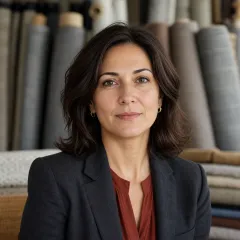
Lucia Bianchi
Lucia Bianchi is a woven apparel-fabric analyst covering cotton, linen, wool, rayon, denim, shirting, twill, satin, poplin, and blended garment fabrics. She applies the ISO 1833 series for fibre composition and ISO 105-C06 for laundering colourfastness while checking GSM, yarn count, usable width, shrinkage, skew, shade grade, drape, and surface defects. Her specification guides help designers, sourcing teams, and mills align fibre claims, lab dips, bulk tolerances, care conditions, and garment performance before production approval.